Flaky Buttermilk Biscuits

Buttermilk biscuits are synonymous with Bisquick in my book.  When I graduated from college, I didn’t realize that you could make biscuits without using Bisquick – unless you wanted to buy some of those Pillsbury biscuits in a metal can that pops when you open it.  Those made very different biscuits than Bisquick – instead of a uniform piece of dough (almost like a scone), you would get some nice flaky layers that you could pull apart one by one.  I have to admit, they are pretty delicious – but there has to be better. So, as I was making the Broccoli and cheese soup – I decided I would give it a try.  I would try and replicate the delicious Pillsbury biscuits, the ones with all the layers.

I found this recipe in Cooking Light – which is always just a little more challenging, especially when making something that needs butter for the magic to happen.  I was skeptical, but the directions kept having me fold the dough over – roll it out, then fold it again.  Well, it worked – because these biscuits were fantastic.  They were definitely mini biscuits, but they were so flakey and delicious – we ate them all.  The kids especially loved them.  They were so easy – it basically took 15 minutes from when I started making them until they were baking in the oven.  I can’t wait to make them again!

Ingredients

  • 9  ounces  all-purpose flour (about 2 cups)
  • 2 1/2  teaspoons  baking powder
  • 1/2  teaspoon  salt
  • 5  tablespoons  chilled butter, cut into small pieces
  • 3/4  cup  fat-free buttermilk
  • 3  tablespoons  honey

Preparation

Preheat oven to 400°.

Weigh or lightly spoon flour into dry measuring cups; level with a knife. Combine flour, baking powder, and salt in a large bowl; cut in butter with a pastry blender or 2 knives until mixture resembles coarse meal. Chill 10 minutes.

Combine buttermilk and honey, stirring with a whisk until well blended. Add buttermilk mixture to flour mixture; stir just until moist.

Turn dough out onto a lightly floured surface; knead lightly 4 times. Roll dough into a (1/2-inch-thick) 9 x 5–inch rectangle; dust top of dough with flour. Fold dough crosswise into thirds (as if folding a piece of paper to fit into an envelope). Re-roll dough into a (1/2-inch-thick) 9 x 5–inch rectangle; dust top of dough with flour. Fold dough crosswise into thirds; gently roll or pat to a 3/4-inch thickness. Cut dough with a 1 3/4-inch biscuit cutter to form 14 dough rounds. Place dough rounds, 1 inch apart, on a baking sheet lined with parchment paper. Bake at 400° for 12 minutes or until golden. Remove from pan; cool 2 minutes on wire racks. Serve warm.

Make about 14 biscuits.

For a printer-friendly version of this recipe, please click here:  Flaky Buttermilk Biscuits

Add to FacebookAdd to DiggAdd to Del.icio.usAdd to StumbleuponAdd to RedditAdd to BlinklistAdd to TwitterAdd to TechnoratiAdd to Yahoo BuzzAdd to Newsvine

Mini-Popovers with Brie Cheese and Dill

I am embarking on a first for my blog.  I am posting something that I have already posted.  These are just too good to pass up – and when I posted them the first time, I was just starting out, so I am not sure too many people saw these.  This recipe was originally printed in Gourmet (yes, paying a little tribute here, because I still miss it each and every month), but I have changed it slightly by updating the cheese and the herb used. 

My family loves these, in fact, polishing off 24 is not a problem at all.  They are super easy to make – you just have to remember to plan ahead and make these an hour before you want them in the oven.  You can use whatever cheese you have in the house – and whatever herbs – or, you can skip the herbs all together – although everything tastes better with fresh herbs.

Happy New Year everyone, and enjoy this recipe, again!

Ingredients

  • 1 cup whole milk
  • 2 large eggs
  • 1 cup all-purpose flour
  • 2 tablespoons unsalted butter, melted, divided
  • 1/2 teaspoon salt
  • 1/8 teaspoon black pepper
  • 1/3 cup finely chopped brie cheese with the rind removed
  • 1 1/2 tablespoons chopped dill
  •  Equipment: a 24-cup mini-muffin pan

Preparation

Whisk together milk, eggs, flour, 1 tablespoon butter, salt, and pepper until smooth, then stir in cheese and dill. Chill 1 hour to allow batter to rest.

Preheat oven to 425°F with rack in upper third.

Butter muffin pan with remaining tablespoon butter, then heat in oven until butter sizzles, about 2 minutes.

Gently stir batter, then divide among muffin cups (they will be about two-thirds full). Bake until puffed and golden-brown, 18 to 20 minutes. Serve immediately.

Makes 24 mini-popovers that you can pop right into your mouth.

For a printer-friendly version of this recipe, please click here:  Mini-popovers with Brie Cheese and Dill

Add to FacebookAdd to DiggAdd to Del.icio.usAdd to StumbleuponAdd to RedditAdd to BlinklistAdd to TwitterAdd to TechnoratiAdd to Yahoo BuzzAdd to Newsvine

Roasted Carrots

My kids love raw carrots (ok, love is a strong word) – they will eat raw carrots, and my younger one requires “dip” – which is ranch dressing.  I have finally gotten them to the point of not removing the cooked carrots from chicken noodle soup – after years of telling them that they are only matter – and that they take on the flavor of the soup – they finally starting believing me and eat them – but only from a can.

Cooked carrots are a whole different story.  I can saute them with butter and dill, serve them with brisket, even boil them in the matzoh ball soup – and they are not fans.  I saw this recipe in Cook’s Illustrated, and I figured I would give it a try.  The carrots sounded delicious – and that they were.  Some were almost crunchy on the outside, and sweet and creamy on the inside – they were magnificent.  When I served them with dinner, my oldest one was intrigued.  My younger one asked if they were french fries.  I might have a winner.  My oldest one tried a carrot, and actually liked it – she ate the whole thing.  My younger one was still skeptical, but I know she will get there.  This is definitely the way to roast carrots – next time I am going to add just a touch of dill, and all will be perfect.   In fact – they might even show up on my Thanksgiving table this year…

Ingredients

  • 1 1/2 pounds carrots, peeled, halved crosswise, and cut lengthwise if necessary to create even pieces
  • 2 tablespoons unsalted butter, melted
  • salt and pepper

Preparation

Adjust oven rack to middle position and heat oven to 425 degrees.  In a large bowl, combine carrots with butter, 1/2 teaspoon salt, and 1/4 teaspoon pepper;  toss to coat.  Transfer carrots to foil or parchment lined rimmed baking sheet and spread in a single layer.

Cover baking sheet tightly with foil and cook for 15 minutes.  Remove foil and continue to cook, stirring twice, until carrots are well browned and tender, 30 to 35 minutes.  Transfer to serving platter, season with salt and pepper to taste, and serve.

For a printer-friendly version of this recipe, please click here:  Roasted Carrots

Add to FacebookAdd to DiggAdd to Del.icio.usAdd to StumbleuponAdd to RedditAdd to BlinklistAdd to TwitterAdd to TechnoratiAdd to Yahoo BuzzAdd to Newsvine

Roasted Radicchio with Lemon Vinaigrette and Breadcrumbs

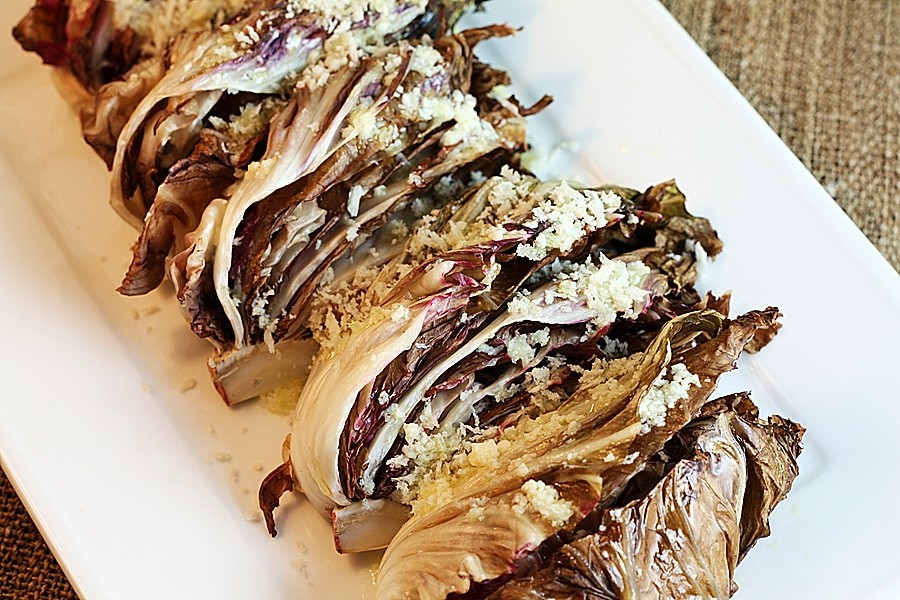
The other week my CSA basket came with a beautiful bunch of radicchio.  A couple of days went by and I still hadn’t figured out what to do with it.  That evening I just happened to open my Bon Appetit, went to my favorite column (written by Molly Wizenberg), and what did I find?  A recipe for Roasted Radicchio with Lemon Vinaigrette and Breadcrumbs.  I have to admit, even I was a little weirded out about the whole thing – what are the chances?  Ok, I guess it is not unheard of that I have some interesting ingredient in the refrigerator that I am looking to use up – but I truly believe this was the first time I ever had radicchio in the refrigerator, and surely one of the few times when I read a recipe where radicchio was the main ingredient.

If you like the bitterness of radicchio, you will love this recipe.  The dressing was wonderful, and the breadcrumbs – now, what doesn’t taste better with breadcrumbs?  The only thing I didn’t like about the dish was that as soon as the radicchio began roasting, it lost its beautiful purple color.  So, sorry for the picture, but this is what it looked like.  So if you can move past the appearance, you will love it.  Now go get yourself some radicchio.

Ingredients

Vinaigrette

  • 3 tablespoons finely grated Grana Padano or Parmesan cheese
  • 2 tablespoons fresh lemon juice
  • 1 garlic clove, pressed
  • Pinch of sugar
  • 5 tablespoons olive oil

Breadcrumbs and Radicchio

  • 4 tablespoons olive oil, divided
  • 1 garlic clove, pressed
  • 2 cups 1/2-inch cubes crustless country white bread
  • 1/4 teaspoon dried oregano
  • 1/8 teaspoon dried crushed red pepper
  • 2 heads of radicchio (about 1 pound total), each cut into 6 wedges with some core attached to each wedge
  • Shavings of Grana Padano or Parmesan cheese (for garnish)

Preparation

Vinaigrette

Mix cheese, lemon juice, garlic, minced anchovies, and pinch of sugar in medium bowl. Whisk in olive oil. Season vinaigrette to taste with salt and pepper. DO AHEAD Can be made 1 day ahead. Cover and chill. Bring to room temperature and rewhisk before using.

Breadcrumbs and Radicchio

Preheat oven to 350°F. Line rimmed baking sheet with foil. Mix 1 tablespoon olive oil and garlic in medium bowl. Add bread cubes, oregano, and crushed red pepper; sprinkle with salt and pepper. Transfer bread cubes to prepared baking sheet.

Bake bread cubes until golden brown, tossing occasionally, about 20 minutes. Cool. Transfer to work surface. Cover with paper towels. Using mallet or rolling pin, crush bread cubes into breadcrumbs.

Preheat broiler. Line same baking sheet with fresh sheet of foil. Place radicchio wedges in large bowl. Drizzle remaining 3 tablespoons oil over; sprinkle with salt and pepper and toss to coat. Arrange wedges on prepared sheet. Broil until beginning to brown, about 3 minutes. Using tongs, turn radicchio over, fanning leaves out slightly. Broil until radicchio is soft and beginning to brown with some edges beginning to char, watching carefully to prevent burning, about 2 minutes longer.

Return radicchio to same large bowl. Drizzle enough dressing over to coat; toss. Arrange wedges on plates. Sprinkle breadcrumbs over. Top with cheese shavings and serve.

For a printer-friendly version of this recipe, please click here:  Roasted Radicchio with Lemon Vinaigrette and Breadcrumbs

Add to FacebookAdd to DiggAdd to Del.icio.usAdd to StumbleuponAdd to RedditAdd to BlinklistAdd to TwitterAdd to TechnoratiAdd to Yahoo BuzzAdd to Newsvine

Golden Corn Salad with Fresh Basil and Arugula

Corn seems to be in season here for months.  Growing up on the east coast, I remember thinking that corn season was so short.  There were only a few weeks when the corn was perfectly sweet, and you had to stop at the local farm stand to get your fill.  I loved that time of year.  My favorite way to eat the corn – take a piece of bread, put a lot of butter on it, then spread it all over the warm cob – sprinkle some salt on top – and delicious.  

When I got older, I realized that corn on the cob was even more delicious without the butter and salt – you could actually taste the sweetness of the corn – instead of just a bunch of salted butter (which don’t get me wrong, was incredible).  What I also realized is that cutting the corn off the cob, and making something out of it – was even better sometimes.  There is really nothing like fresh corn, just off the cob.  The corn oozes with juice and sweetness.

I saw this recipe in Cooking Light, and decided that I had to buy the last of the corn at the farmer’s market to try this out.  Since corn is seriously in season all summer long (not sure how, but let’s go with it), there was no shortage.  I also picked up some fresh arugula, potatoes, red pepper, and queso fresco while I was at the farmer’s market – and when I got home, my husband had a small bowl of cherry tomatoes waiting for me – so I threw those in as well.  The result was a magical garden salad that was amazing.  The dressing was very light – and it was a perfect end of summer salad.

Ingredients

  • 8  ounces  small yellow Finnish potatoes or small red potatoes
  • 3  cups  fresh corn kernels (about 4 ears)
  • 2  cups  assorted cherry tomatoes, halved
  • 1 1/2  cups  chopped red bell pepper
  • 1/4  cup  minced shallots
  • 3  tablespoons  white balsamic vinegar
  • 1  tablespoon  Dijon mustard
  • 1/2  teaspoon  kosher salt
  • 1/4  teaspoon  black pepper
  • 3  tablespoons  extra-virgin olive oil
  • 6  cups  arugula, trimmed
  • 1/2  cup  torn fresh basil leaves
  • 2  ounces  queso fresco, diced

Preparation

Place potatoes in a small saucepan; cover with water. Bring to a boil; cook 11 minutes or until tender. Drain and chill. Cut potatoes in half lengthwise. Combine potatoes, corn, tomatoes, and bell pepper in a large bowl.

Combine shallots and next 4 ingredients (through black pepper) in a small bowl, stirring with a whisk. Slowly pour oil into shallot mixture, stirring constantly with a whisk. Drizzle over corn mixture; toss well. Add arugula; toss. Sprinkle with basil; top evenly with queso fresco.

Serves 4-6

For a printer-friendly version of this recipe, please click here:  Golden Corn Salad with Fresh Basil and Arugula

Add to FacebookAdd to DiggAdd to Del.icio.usAdd to StumbleuponAdd to RedditAdd to BlinklistAdd to TwitterAdd to TechnoratiAdd to Yahoo BuzzAdd to Newsvine

Succotash

It is really no surprise that my kids do not like Succotash.  What kid would like something called that?  I looked up the definition, and it is “a food dish consisting primarily of corn and lima beans or other shelled beans.”  They even go so far as to say that you can add other ingredients like tomatoes or red peppers, how lovely.  Kids love corn – but the name Succotash makes it seem like they are eating something foreign. 

I love Succotash, and decided that I would make it for our annual block party.  I was so excited to finally use the edamame in the freezer downstairs.  The only problem was, I guess that edamame was older than I thought – the beans had basically died – in the freezer.  They had such bad freezer burn, they were finished.  I panicked.  I had no time to run to the market to get another bag – so I went to the refrigerator to see what I could find.  A friend of mine had been visiting the week before and brought me some beautiful beans from her garden – how lucky was I that these beans were actually so big, that there were nice looking peas inside.  I tried to remember exactly what they were – but at that point, it didn’t matter.  I was shelling the beans, and I came up with a nice bowl of beautiful peas.  The shells seemed too big to eat – so they must have been peas.  Ok, so I didn’t have 16 oz., but I had enough to serve the dish.  Phew!

The Succotash was a huge hit – I will definitely have to make this recipe from Cooking Light again, next time with a nice bag of edamame – but the peas were an excellent substitution in a pinch – and based on the definition, any shelled bean will do.

Ingredients

  • 1  slice center-cut bacon
  • 1  tablespoon  butter
  • 2  cups  chopped sweet onion
  • 2  cups  fresh corn kernels (about 3 ears)
  • 1  (16-ounce) bag frozen, shelled edamame, thawed
  • 2  tablespoons  red wine vinegar
  • 1/2  teaspoon  salt
  • 1/2  teaspoon  freshly ground black pepper
  • 1/2  teaspoon  sugar
  • 3  plum tomatoes, coarsely chopped
  • 1  red bell pepper, seeded and coarsely chopped
  • 3  tablespoons  torn basil

Preparation

Cook bacon in a nonstick skillet over medium heat until crisp. Remove bacon from pan, reserving 2 teaspoons drippings in pan; coarsely chop bacon.

Increase the heat to medium-high. Melt butter in drippings in pan. Add onion; sauté 3 minutes, stirring occasionally. Add corn kernels; sauté for 3 minutes or until lightly charred. Add edamame, and sauté for 3 minutes, stirring occasionally. Stir in vinegar and next 5 ingredients (through bell pepper); cook 30 seconds, stirring occasionally. Sprinkle with bacon and basil.

For a printer-friendly version of this recipe, please click here:  Succotash

Add to FacebookAdd to DiggAdd to Del.icio.usAdd to StumbleuponAdd to RedditAdd to BlinklistAdd to TwitterAdd to TechnoratiAdd to Yahoo BuzzAdd to Newsvine

Pasta Salad with Cherry Tomatoes and Green Olivada

We have had such a cold summer, it is no surprise that we still don’t have ripe cherry tomatoes in our garden.  Maybe in the next couple of days – with our temperature finally in the 90s.  Usually I wait all summer for those babies to be ripe, and I hold off on all my good tomato dishes.  This year – I figured I would be waiting forever, so I actually had to buy some at the store just to make this recipe I found in Bon Appetit.  It looked so good, I couldn’t wait. 

 The olives gave this pasta salad so much flavor, and the fresh mozzarella and tomatoes were like icing on the top.  The colors were beautiful, and it make a perfect side dish with our burgers and dogs.  I can’t wait until our cherry tomatoes are ripe in the garden, so I can make this again.

Ingredients

  • 1 garlic clove, peeled
  • 2 cups coarsely chopped pitted green olives (from about 6 ounces unpitted whole olives), divided
  • 3 tablespoons capers, drained
  • 1 tablespoon red wine vinegar
  • 1 teaspoon anchovy paste
  • 1 tablespoon Dijon mustard
  • 1/4 teaspoon dried crushed red pepper
  • 1/2 cup plus 1 tablespoon extra-virgin olive oil
  • 1 pound gemelli, fusilli, or rotelle pasta
  • 2 pints cherry tomatoes or grape tomatoes, halved
  • 1 8-ounce package small (cherry-size) fresh mozzarella balls in water
  • 2 tablespoons chopped fresh oregano

Ingredient Tip

Fresh mozzarella balls packed in water are available at many supermarkets and at specialty foods stores and Italian markets.

Preparation

With machine running, add garlic clove to processor through feed tube and process until finely chopped; turn off machine. Add 1 cup chopped olives, capers, red wine vinegar, anchovy paste, mustard, and crushed red pepper. Using 6 on/off turns, process to chop coarsely. With machine running, gradually add 1/2 cup olive oil, forming coarse puree. Transfer to bowl; stir in remaining 1 cup olives. Season olivada to taste with salt and pepper. DO AHEAD Olivada can be made 3 days ahead. Cover and refrigerate.

Cook pasta in large pot of boiling salted water until just tender but still firm to bite, stirring occasionally. Drain well. Transfer drained pasta to large bowl. Drizzle remaining 1 tablespoon oil over pasta; toss to coat. Cool, stirring occasionally.

Add olivada, halved tomatoes, mozzarella, and oregano to pasta; toss to coat. Season to taste with salt and pepper.

Serves 6 as a side dish.

For a printer-friendly version of this recipe, please click here:  Pasta Salad with Cherry Tomatoes and Green Olivada

Add to FacebookAdd to DiggAdd to Del.icio.usAdd to StumbleuponAdd to RedditAdd to BlinklistAdd to TwitterAdd to TechnoratiAdd to Yahoo BuzzAdd to Newsvine

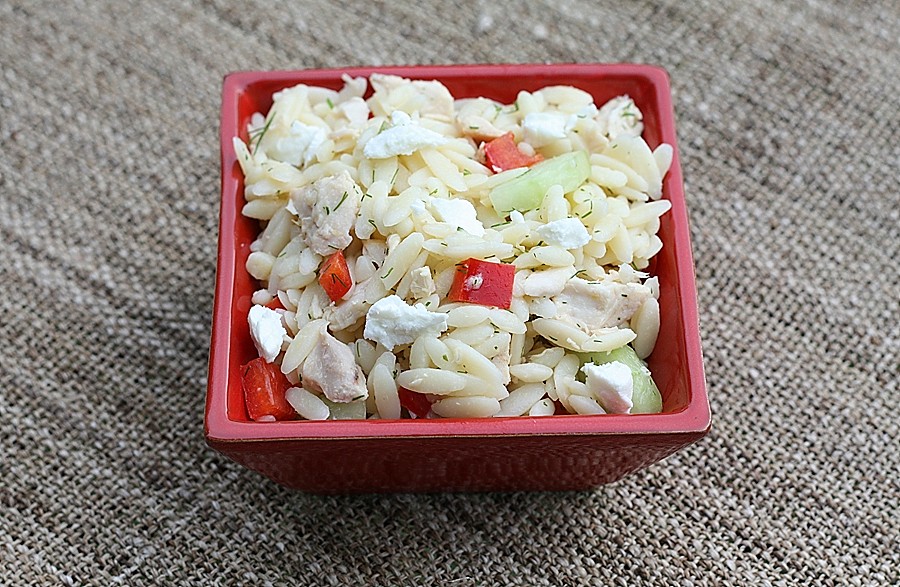
Lemony Orzo – Veggie Salad with Chicken

One of my favorite summertime dishes is to make an orzo salad with chicken mixed in.  Add a little dill and a lemon vinaigrette, and you’ve got yourself a perfect meal, especially when it is hot outside.  I usually make a big batch of it and bring it to our community swimming pool for Sunday night dinner.  It is my hope that someday even the kids will go nuts over it.

I saw this recipe in Cooking Light, and it looked just like the version I make (sans the recipe).  I decided to give it a try to see how it compared.  I have to wonder if somehow there was a secret camera hidden in my kitchen that watched me make this – it was just like my own rendition.  It was so delicious and light, you just couldn’t help but have seconds and thirds.  The kids didn’t know what they were missing, but had they known, there wouldn’t have been as much for the adults…I guess when they are finally able to appreciate this pasta salad, I will have to double the recipe.

Ingredients

  • 3/4  cup  uncooked orzo
  • 1/4  teaspoon  grated lemon rind
  • 3  tablespoons  fresh lemon juice
  • 1  tablespoon  extra-virgin olive oil
  • 1/2  teaspoon  kosher salt
  • 1/2  teaspoon  minced garlic
  • 1/4  teaspoon  honey
  • 1/8  teaspoon  freshly ground black pepper
  • 1  cup  shredded skinless, boneless rotisserie chicken breast
  • 1/2  cup  diced English cucumber
  • 1/2  cup  prechopped red bell pepper
  • 1/3  cup  thinly sliced green onions
  • 1  tablespoon  chopped fresh dill
  • 1/2  cup  (2 ounces) crumbled goat cheese

Preparation

Cook orzo according to package directions, omitting salt and fat. Drain and rinse with cold water; drain and place in a large bowl.

While orzo cooks, combine lemon rind and next 6 ingredients (through black pepper), stirring well with a whisk. Drizzle juice mixture over orzo; toss to coat. Add chicken and next 4 ingredients (through dill); toss gently to combine. Sprinkle with cheese.

Serves 4.

For a printer-friendly version of this recipe, please click here:  Lemony Orzo – Vege Salad with Chicken

Add to FacebookAdd to DiggAdd to Del.icio.usAdd to StumbleuponAdd to RedditAdd to BlinklistAdd to TwitterAdd to TechnoratiAdd to Yahoo BuzzAdd to Newsvine

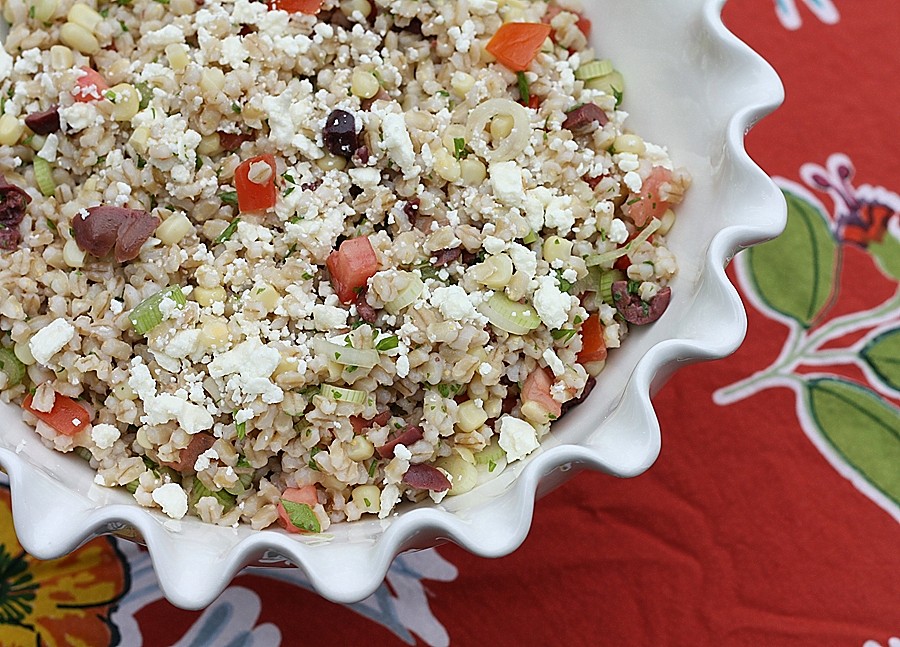
Summer Barley Salad

I have really started to like making salads out of barley.  It is much healthier than pasta, and has a great nutty flavor.  I have never much been into cold rice salads, so this is a perfect alternative.  I saw this recipe in Cooking Light, and I was so excited – I had been thinking about all the barley I had in the pantry, and how I was going to use it.

The first time I made barley, it turned out almost like a risotto – and even though when mixed with the rest of the ingredients, it still tasted great – for some reason I was just not satisfied with the texture.  The next time I made barley, I decided to rinse it after I was finished cooking.  That definitely did the trick – and the barley didn’t all stick together.  From now on, I always rinse the barley after I am done cooking it.  Not only does it cool the barley off, but the grains don’t stick to each other, and allows all the other ingredients to mingle in just the right way.

Now I just need to get my kids to start eating it…and when I do, then I know I was successful.  Even though the kids didn’t like this salad, all the adults I served it to LOVED it.  There were hardly any leftovers, and there were only 4 adults.  The flavors were wonderful, just perfect along side the grilled steak we had for dinner.  This is definitely a summer salad keeper.

Ingredients

  • 1 1/2  cups  uncooked pearl barley
  • 1  cup  fresh corn kernels (about 2 ears)
  • 1  cup  diced seeded plum tomato (about 2 small)
  • 1/2  cup  chopped green onions
  • 1/4  cup  chopped fresh flat-leaf parsley
  • 20  kalamata olives, pitted and coarsely chopped
  • 3  tablespoons  fresh lemon juice
  • 2  tablespoons  olive oil
  • 1/4  teaspoon  salt
  • 1/4  teaspoon  freshly ground black pepper
  • 1  garlic clove, minced
  • 3/4  cup  (3 ounces) crumbled feta cheese

Preparation

Cook barley according to package directions, omitting salt. Drain and rinse with cold water; drain. Cool completely. Combine barley, corn, and next 4 ingredients (through kalamata olives) in a bowl. Combine juice and next 4 ingredients (through garlic), stirring well with a whisk; drizzle over barley mixture. Toss to coat. Sprinkle with cheese.

Serves 8 as a side dish.

For a printer-friendly version of this recipe, please click here:  Summer Barley Salad

Add to FacebookAdd to DiggAdd to Del.icio.usAdd to StumbleuponAdd to RedditAdd to BlinklistAdd to TwitterAdd to TechnoratiAdd to Yahoo BuzzAdd to Newsvine

Israeli Couscous with Asparagus and Red Peppers

I don’t know what it is about grilling season, but I am constantly looking for great sides that can be served warm or cold next to some nice grilled meat fresh off the BBQ.  I am a huge fan of couscous – but then one day I discovered Israeli couscous…I love those little balls of pasta – they are so perfect with fresh vegetables, and make a delicious side dish that you can serve at any temperature.  I remember trying to explain Israeli couscous to my daughters one evening – I told them that they were like rice except that they were pasta.  Then I had to explain the difference between rice and pasta – and that rice is a grain, and pasta is made from semolina flour, etc…and the conversation got way too complicated pretty quickly.

I saw this recipe in Bon Appetit, and it reminded me that I had a package of Israeli couscous in the pantry.  The vegetables in the recipe though didn’t do it for me – they were all green.  I felt that like I needed some additional color in there, so I modified the recipe slightly below.  The fresh lemon dressing was excellent – be sure to use fresh lemon  juice for this one, it is worth it.  I served this with some nice steaks that my husband grilled, and the dinner was a huge hit – we ate every last bit of the couscous.  My favorite part of this recipe?  You can substitute whatever vegetables you have in your garden, or refrigerator.  This will be on our menu a lot this summer.

Ingredients

  • 4 tablespoons extra-virgin olive oil, divided
  • 2 tablespoons fresh lemon juice
  • 2 large garlic cloves, minced, divided
  • 1/2 teaspoon finely grated lemon peel
  • 1 1/3 cups Israeli couscous (6 to 7 ounces)
  • 1 3/4 cups (or more) vegetable broth
  • 14 ounces slender asparagus spears, trimmed, cut diagonally into 3/4-inch pieces (about 2 1/2 cups)
  • 1 red bell pepper, chopped
  • 1/3 cup chopped fresh chives
  • 1/2 cup finely grated Parmesan cheese

Test-Kitchen Tip

To trim asparagus, hold onto the top of the stalk with one hand and bend the bottom of the stalk with your other hand. The stalk will snap, separating the woody end from the tender top.

Preparation

Whisk 2 tablespoons oil, lemon juice, 1 garlic clove, and lemon peel in small bowl; set dressing aside. Heat 1 tablespoon oil in heavy medium saucepan over medium heat. Add couscous, sprinkle with salt, and sauté until most of couscous is golden brown, about 5 minutes. Add 13/4 cups broth, increase heat, and bring to boil. Reduce heat to medium-low, cover, and simmer until liquid is absorbed and couscous is tender, about 10 minutes, adding more broth by tablespoonfuls if too dry.

Meanwhile, heat remaining 1 tablespoon oil in heavy large nonstick skillet over high heat. Add asparagus, sugar snap peas, green peas, and remaining garlic clove. Sprinkle with salt and pepper; sauté until crisp-tender, about 3 minutes. Transfer vegetables to large bowl.

Add couscous to bowl with vegetables. Drizzle dressing over. Add chives and cheese; toss. Season with salt and pepper.

Serves 6.

For a printer-friendly version of this recipe, please click here:  Israeli Couscous with Asparagus and Red Peppers

Add to FacebookAdd to DiggAdd to Del.icio.usAdd to StumbleuponAdd to RedditAdd to BlinklistAdd to TwitterAdd to TechnoratiAdd to Yahoo BuzzAdd to Newsvine